Showing posts with label Louder than Words. Show all posts

Wednesday, May 12, 2010

Speaking with Chelsey Shannon, Author of Teen Memoir, "Chelsey"

When Chelsey Shannon's only surviving parent — her beloved father — was violently murdered days before her 14th birthday, her life was forever changed. Chelsey struggled to make sense of her personal tragedy and find a way to flourish despite the odds.

The author of Chelsey in the "Louder Than Words" series, Chelsey Shannon is currently editing a play to be produced by her school — The School for the Creative and Performing Arts — and is beginning her first novel. "It's something I never actually thought I would do, so that's pretty exciting," she says.

The Louder than Words series, edited by Deborah Reber, www.smartgirlsknow.com, is the first-ever series of teen-authored memoirs, written by teens for teens.


What led you to start writing?
I've been writing since I was in grade school, but I started writing even more after my dad's death. It was a good outlet for my emotions. While it was also therapeutic and important for me to cry and talk to my loved ones about my feelings, I really poured my heart into writing because I felt like it produced a positive result — a creative piece of work — from something so devastating and negative.

How did you decide which parts of your experience to include in your memoir?
Really, it was a surprisingly organic progress. When I first sat down to write the outline to follow for my book, I just kind of jotted events down as they came. I added a few more and switched things around, but for the most part, I included the things that instinctively struck me as significant in the book.

What was your favorite part of writing the book? The greatest challenge?
The most difficult part of writing my book was the beginning, the first few months after my dad's death. My favorite part was writing about the healing that began to occur about a year after he died. The writing actually helped me see for the first time how far I'd come from the grieving, painfully shy girl I was for about a year after my dad's death, and see all the positive changes that came from moving to SCPA.

Each author page has a "play list" for her book. Why did you choose those songs for your soundtrack?
Many of them are songs I listened to shortly before or after my dad's death, so I've come to connect them with him. Others, such as the Phantom of the Opera selection, sum up my situation pretty perfectly. Plus, it's my favorite musical.

Who are some of your favorite authors?
Victor Hugo, Kurt Vonnegut, Gabriel Garcia Marquez, Vladimir Nabokov.

What do you know now that you wish you knew when you first started writing?

Hm…probably don't be afraid to try to be funny. I don't think find my book boring; I think the tone is appropriate for the subject matter. If I'd been a total jokester it would have cheapened the meaning of my story. But I don't think it would have hurt to have thrown a few jokes in during the second half of the book, even if they weren't really that funny.

Advice for young writers?
Don't be afraid to write a poor first draft. In that initial first rush of creativity, all that matters is getting everything down. You can polish it up later on.

Wednesday, April 21, 2010

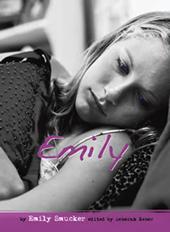
Speaking with Emily Smucker, Author of Teen-Memoir "Emily"

Emily Smucker, the 19-year-old author of Emily in the "Louder Than Words" series, is a Mennonite writer who loves to drink tea, wear bright colors, and blog about her unpredictable life.

Plagued with some sort of cold or fever or bizarre ache or pain for much of her life, Emily thought the dizziness and stomachaches at the start of her senior year were just another bout of “Emily flu.” She was eventually diagnosed with the rare and incurable West Nile virus.

The Louder than Words series, edited by Deborah Reber, www.smartgirlsknow.com, is the first-ever series of teen-authored memoirs, written by teens for teens.


What led you to start writing?
I've always loved making up stories, and when I was about ten I began to try writing them down. It was very frustrating at first. I could never seem to finish a story once I started it. But the more I did it, the better I got, and the more I fell in love with it. By the time I was 15 I was carrying a notebook around with me everywhere I went. The blogging craze hit my group of peers around that time, and so I started a blog. But while they have since abandoned their blogs, I still blog regularly, and it has been a tremendous help in my writing.

How did you decide which parts of your experience to include in your memoir?
Writing my memoir was sort of like putting a puzzle together. I took all my blog and diary entries from that year and tried to fit them together. What I ended up eliminating was the stuff that didn't contribute to the big picture. Well, basically stuff that I felt was too personal or too stupid, or that mentioned some person or place that would be confusing to the reader, since I never spoke of it before or since.

How is blogging similar to/different than writing a memoir?
There are two main differences that I see. First of all, writing a memoir was like putting a puzzle together, trying to figure out how little snippets of my life fit into a big picture. When I blog, however, I just jot down whatever I feel like saying, and don't have to worry about how it ties in to another piece of work.

The second main difference is the fact that a book is much more important and long lasting than a blog post. If I post something stupid on my blog, no one is going to go back in the blog archives five years from now and laugh at me. Unless they are a stalker. With my book, though, someone could easily read it five years from now.

The bottom line is, writing a memoir is a lot more of a careful precise job than writing a blog post.

What was your favorite part of writing the book? The greatest challenge?

My favorite part of writing the book was watching little snippets of my life turn into a complete story. It made me feel like perhaps my pain had been worth something, if it could be turned into an interesting story.


The greatest challenge, no question, was editing. It didn't help that I was trying to edit it on my mom's laptop while driving from Oregon to Colorado. Needless to say, I got somewhat carsick.


Each author page has a "play list" for her book.
Why did you choose those songs for your soundtrack?
When my editor told me I should pick out a playlist of songs, I was in a bit of a quandary. I almost never listen to music. I have a few songs that I like and that I listen to over and over again, but none of them really seemed to go along with my book.


So I called my friend Bethany. She is sort of obsessed with music. She made up a HUGE list of songs she thought I might like, and after listening to every single one I finally found three that I sort of liked.

"I have a Dream," by ABBA
- This one had a pretty tune and it reminded me of all the beautiful dreams for my future I had while being sick. Dreams were sort of my lifeline.


"Fireflies," by Faith Hill
- Bethany always said this song reminded her of me. It describes the way I like to imagine and dream.


"Beauty from Pain," by Superchic[k]
- When I wrote my book, I felt like I was finally seeing something beautiful, a story, come out of my pain. That's why I chose this song.


I added "You," by Switchfoot, because I think it is probably my favorite song. It is so hauntingly beautiful and it describes how I feel about God. Ultimately, it's not about me, it's about Him.
...


If I could contribute to the list now, I would probably add some Owl City songs, like "Fireflies" or "Hot Air Balloon," because the sort of dreamy randomness is similar to the way I think and wrote my book. I would also add "We Could Run Away" by Needtobreathe, because it describes the way I always wished I could just run away and fix my life somewhere else.

Who are some of your favorite authors?
My favorite books to read are middle grade fiction books, so my favorite authors are usually ones that have won the Newbery award or honor at some point. This includes Jerry Spinelli, Lous Sachar, Gail Carson Levine, Shannon Hale, Sharon Creech, E. L. Konigsburg, Kate DiCamillo, Robin McKinley, Lloyd Alexander, and Avi.

What do you know now that you wish you knew when you first started writing?
If you write and write and write, eventually you'll be able to finish a story. Don't be discouraged if you can't do it now. You will learn, eventually.

Advice for young writers?

I would advise young writers to start a blog. There are so many ways that blogging can be helpful to a writer. I once made a decision to post at least once a week, and this has helped me learn to be disciplined as a writer. Blogging has helped me determine what is boring and what is fascinating to readers, based on the number of hits or comments I get. People saw me as a real writer when I began blogging, and when the time came to write a memoir, 40% of it was already done and on my blog.


What's next?

Hopefully a novel with a teenage Mennonite girl as a protagonist. Different plots have gone through my head, but none have formed themselves into a novel yet. Sometimes I doubt that I am capable of writing a novel at 19. But who knows? After all, I wrote (well, mostly compiled) a memoir when I was 18!

Wednesday, March 31, 2010

Speaking with Marni Bates, Author of Teen Memoir "Marni"

Marni Bates is the author of Marni in the "Louder Than Words" series, which was selected for the New York Public Library's Stuff for the Teen Age List (2010).

Marni, who suffers from trichotillomania (an obsessive need to pull out her hair, eyebrows, and eyelashes), alternates her time between her home in Ashland, Oregon, and Lewis & Clark College. When not studying or writing, she can be found rollerblading, bargaining at garage sales, and watching copious amounts of TV — strictly for artistic inspiration, of course.

The Louder than Words series, edited by Deborah Reber, http://www.smartgirlsknow.com/, is the first-ever series of teen-authored memoirs, written by teens for teens.


What led you to start writing?
My fifth grade teacher, Mrs. Badger, had everyone write a short story in her class. Mine was about fairytale characters that complained and commiserated with each other while children slept. After that, I was hooked. Mrs. Badger also took me aside and said she wanted me to remember her when my books were published someday. She knew I was a writer long before I did. I’m incredibly lucky to have received such encouragement and support.

How did you decide which parts of your experience to include in your memoir?
The first thing I did was pan my memory for pivotal moments and people. I searched for anecdotes, or better yet, flashes of awareness. For example, I wanted to capture the moment I realized my dad didn’t really know me and couldn’t truly love me. And I wanted to write about the pivotal moments that led up to that epiphany. My goal was for the readers to feel like they knew me. Which meant that I had to show the people, places, and things that shaped me into the person that I am. I also think this approach helps people understand that my trichotillomania (obsessive need to pull out my hair, eyebrows, and eyelashes) is just a part of my life. It’s important to me that people don’t just define me as “the girl who pulls.” Because there’s so much more to me than that. Just like there is more to someone who suffers from anorexia than an unhealthy relationship with food.

Were there any sections/details you eliminated that you wish you kept?
Nope. I don’t think I eliminated much of anything. Actually, there are lots of things I wish I could add! My book was being printed when I remembered several experiences that would have fit in perfectly. Sadly, it was not to be. If I were to make one change to the book now, though, I’d alter all of the names. A few people were not very happy about the lack of effort I made to conceal their identities. In hindsight, I should have done more to ensure their comfort.

What was your favorite part of writing the book? The greatest challenge?
There is no particular part that strikes me as my favorite. Editing was the most grueling, but it was also fascinating and rewarding for me to watch my work tighten. At times it was difficult to channel painful events from my past, but my book was a way to battle the snarky voice in my head that says I’ll never be good enough. And expressing myself, saying both in public and on paper that I have trichotillomania, was every bit as good for me as therapy. I’m a stronger, happier person because of my autobiography. So I look back on the process with a fondness that I didn’t always feel when I had a French test and an essay due the same week as a chapter on my pulling.

Each author page has a "play list" for her book. Why did you choose those songs for your soundtrack?
I had such a great time making my playlist! I have a horrible tendency to glob onto a handful of songs and play them non-stop until even I am sick of them. The songs I chose have somehow managed to survive my endless loop intact. I listened to all of them at some point during my writing process and owe them for preserving a large chunk of my sanity. The hardest part for me was limiting the number of songs I put on the list! I tried to get a blend of fast-pace upbeat songs with slower more contemplative songs. The one song I had to include was "Come As You Were" by The Bird and the Bee, because it reminded me to stay honest with myself. Hopefully, I’ll be able to update the list at some point to include some of my more recent favorites.

Who are some of your favorite authors?
I highly recommend Meg Cabot, Gordon Korman, and Julie Andrews. All three of them write wonderful books for teenagers that make you wish that you could see ghosts, or you knew someone from Pefkakia, or you could go to Whangdoodleland, or that you could be best friends with the main characters. That’s how I’ve always felt anyway. Which might explain why I think of them as YA royalty that I’d do anything to meet. Because that doesn’t make me sound stalker-y or anything ...

What do you know now that you wish you knew when you first started writing?
I wish I had realized the value in a limited amount of advice. The first novel I wrote my mom e-mailed to a number of her friends, and everyone came back with a boatload of comments for me, the majority of which were nit-picky or straight up awful! Because how do you respond when someone tells you they hope your character finds God and inner peace? I’d have saved myself a very painful headache by just trusting my instincts and listening to two other people, three tops.

Advice for young writers?
Write for yourself and write what you want to read. If you find something funny there’s a very good chance that other peoples will too. And if, absolute worst-case scenario, no one else enjoys it, well, you did. Which means, no matter what it is, it can’t possibly be a failure or a waste of your time. And don’t forget that you are the writing expert when it comes to your story. Trust that.

What's next?
Books and more books! I’ve got one in the works and an old manuscript that needs a bit more polishing before I’ll be satisfied. My goal is to write at least one book every year for the rest of my life. I’ve managed it for the past two years, so hopefully my writing streak will continue. I’m a full-time college student, and am toying with the idea of being an au pair for a year after I’ve graduated. Then maybe I’ll look for an internship somewhere. For now, I’m just concentrating on writing what makes me happy.